

From Raw Stone to Sovereign State: Freemasons and the Revival of Nations
Our national holiday period – the sharp transition from Memorial Day to Independence Day – is an annual reminder that countries do not grow out of thin air. Nation-building, just like building a temple, requires vision, sacrifice, hard work, and most importantly – architects who see the big picture.
Our Order has never been a political organization, and it prohibits engaging in partisan politics within the walls of the Lodge. However, the universal values we hold sacred – liberty, equality, fraternity, tolerance and freedom of conscience – have always served as a beacon for visionaries around the world. As we celebrate the rebirth of the State of Israel and our independence, it is fascinating to look back and see how brothers of the order, who were educated on the same symbols and tools we use today, formed the backbone of independence and national revival movements across the globe.
🇺🇸 The Founding Fathers of the United States: Liberty as a Masonic Ideal
The most famous connection between freemasonry and statehood is found in American history. The founding values of the United States cannot be separated from Masonic philosophy.
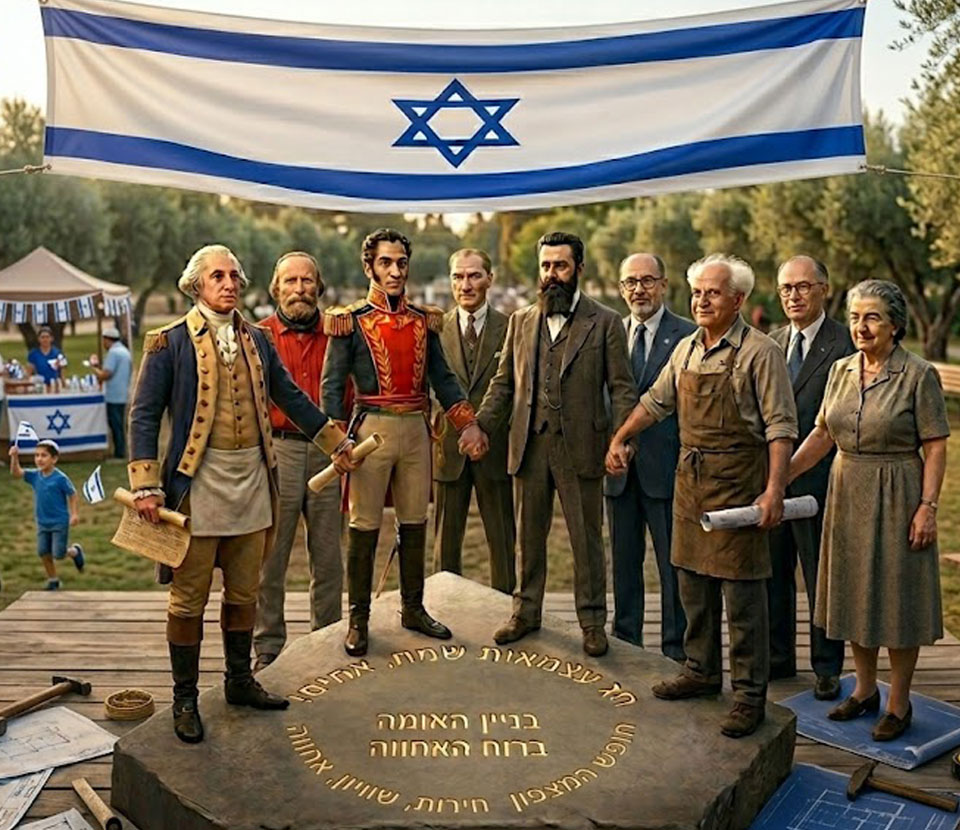
- George Washington: The first president and commander of the Continental Army, he was a proud Freemason (and even served as president of the “Alexandria Lodge No. 22”). He laid the cornerstone for the Capitol in a full Masonic ceremony, wearing the order’s apron.
- Benjamin Franklin: Drafter of the US Constitution and one of the most important diplomats of his time, he served as Grand President of the Grand Lodge of Pennsylvania. Franklin even printed the first Masonic constitution in America.
- They are joined by many brothers such as Paul Revere and John Hancock (whose huge signature is on the Declaration of Independence), who turned the ideas of the European Enlightenment movement – which were cultivated within the lodges – into a constitutional and democratic reality.
The “liberators” of South America
In the 19th century, the South American continent burned with a desire to free itself from the yoke of the Spanish Empire. At the center of this struggle were Freemason brothers who founded dedicated lodges (such as the famous “Lautaro Lodge”) that served as a focus for planning and free thinking.
- Simon Bolivar (“The Liberator”): The man who led to the independence of Venezuela, Colombia, Ecuador, Peru, and Bolivia. Bolivar was dedicated to Freemasonry in Spain and drew many of the order’s concepts of fraternity and freedom into his political vision.
- José de San Martín: Hero of the independence of Argentina, Chile, and Peru, was also an ardent Freemason. Legend has it that the Masonic connection between San Martín and Bolivar was a decisive factor in their historic meeting in Guayaquil, where they agreed to divide responsibilities between them for the liberation of the continent, out of mutual respect as brothers.
🇮🇹 Italian Unification: A Vision of National Brotherhood
In 19th-century Europe, ideas of national liberation were also often driven by Freemasons. The most obvious example is the revival and unification of Italy (the “Risorgimento”).
- Giuseppe Garibaldi: The Italian general and national hero who unified the country, was not only a Freemason, but also later served as the Grand President of the Grand Lodge (Grand Orient) of Italy. For Garibaldi, the struggle against governmental and religious tyranny was a direct continuation of his Masonic work for the advancement of humanity.
🇮🇱 And back home: the spirit of construction in Israel
Although the Zionist movement was established as an independent national movement, it cannot be ignored that many of the founders of the settlement and the state adopted values parallel to those of the Order. Our Declaration of Independence, which promises “complete equality of social and political rights to all its citizens without distinction of religion, race, or sex” and guarantees “freedom of religion, conscience, language, education, and culture,” is a text that any Freemason can read and feel at home with.
On this Independence Day, as we see the challenges facing Israeli society, our role as Freemasons takes on new significance. A country, like a quarry stone, requires constant maintenance, sanding, and adjustment to remain stable. Our work within the Chamber – learning tolerance, listening to others, mutual aid, and accepting brothers from all walks of life – is a microcosm of the ideal Israeli society we strive to build outside.
The Founding Fathers of the United States, the liberators of South America, and the heroes of Italy, used Masonic tools to establish countries. Our role, here and now, is to use those same tools to preserve our country, heal the wounds, and ensure that the light of “liberty, equality, and fraternity” continues to illuminate our path.